The Alexicon has done a deep dive already into the context surrounding Candide, but Voltaire wasn’t the only satirist active during the 18th century. Alexander Pope, John Gay, and the star of today’s piece, Jonathan Swift, all wrote notable satirical works, and Gay was actually responsible for The Beggar’s Opera, the satirical show which we mentioned in our previous article, A Beginner’s Guide to 18th-Century Opera. Writing style, length, and selected topics varied by author, but these people all made notable contributions to the intellectual culture of the time and are therefore deserving of some recognition.
Today, we’ll be focusing on Swift’s arguable most famous satirical work, an essay called A Modest Proposal. This story reads like a traditional economic essay, attempting to “logically” convince the Irish populace to follow Swift’s idea of how to alleviate poverty in Ireland. He modestly proposes that in order to both make extra income and prevent having more mouths to feed on an already strained budget, that the Irish poor raise and sell their infant children as delicacies for the English to eat1. Obviously, this is an alarming idea, and not one that’s meant to be taken literally, but if you know the context behind the work, it becomes a fascinating piece of social commentary. Before we get into Ireland’s tumultuous history, though, let’s get familiar with this essay’s author.
Disclaimer: I always try to write with as little personal bias as possible, but I must be upfront about the fact that I do honestly agree with Swift’s complaints about England’s conduct during this period. It is my belief that England was legitimately in the wrong, and though I know many wonderful English people, I cannot defend their country’s conduct towards Ireland during the 18th century. Still, I will endeavor to present objective facts, not my own opinions.
A Short Biography:

Jonathan Swift was a prolific writer of essays, stories, and political pamphlets, best known for his novel, Gulliver’s Travels and satirical essay, A Modest Proposal. He actually wrote dozens more works, but his more traditional legal and economical treatises aren’t familiar material to the average reader. Born in Dublin, Swift spent a number of his early adult years in England before returning to his homeland to serve as the Dean of St. Patrick’s Cathedral, Dublin2. He actually came from a family with quite a poetic legacy, with even a distant connection to the godson of William Shakespeare, William Davenant3. Swift was a well-educated man, earning two degrees from Trinity College Dublin and an additional degree from Oxford, and his work was interacted with by readers from a wide variety of backgrounds4. He had a tendency to write with a very straightforward style, even when he was composing poetry, which was unusual for the time. After all, Swift’s contemporaries, such as John Dryden and Alexander Pope, tended to use much more ornamentation and figurative language5. In fact, one can argue that Swift honestly took very little inspiration from other writers, focusing minimally on meter and imagery and maintaining an unusual style.
He eventually died at the age of approximately 77 (there’s some debate about his original birth date), living nonverbally for three years due to a stroke before finally succumbing to ill health. Following a rather consistent pattern of charitable efforts, Swift bequeathed much of his considerable fortune to the establishment of St. Patrick’s Hospital for the Mentally Ill, which still operates today as Ireland’s largest nonprofit mental health care provider.
England’s “Subordination” of Ireland, and the Penal Laws
Many people are familiar with the 19th-century potato famine in Ireland, but not everyone is aware of the fact that the island had already been under British control for centuries before that. First invaded in 1169, Ireland was believed by some to be England’s (and the later British Empire’s) first colonial experiment6. Colonists spread across conquered Ireland over the following centuries, “bringing with them their English language, fashions, culture, and commercial ways, which parliamentary legislation privileged while outlawing Irish language and dress, together with Irish agricultural, social, political and cultural practices7”.
During periods of resistance, English armies showed little mercy to their adversaries. In the Nine Years’ War (1594-1603), scorched earth tactics and starvation were two of the main weapons used to weaken the rebels8. In the 1640’s, approximately 20% of Ireland’s entire population died due to a combination of disease, war, and exposure, especially after Oliver Cromwell took control of the British Commonwealth as Lord Protector. Farmland and estates throughout the country changed hands from Irish Catholics to English Protestants9. The Penal Laws, which were designed to take away rights from Irish Catholics and Roman Catholics in general, were passed by Parliament. They forbid the Irish from voting, owning weaponry, teaching at schools, and countless other things, systematically stripping Irish Catholics of their rights, freedoms, and property over a period of many years10. Such restrictions were one of many examples which Enlightenment philosophers took on in the subsequent decades, but change was slow, and many Irish were slowly forced into situations of poverty and political voicelessness through such codes. For example, look at this excerpt:
“No Papist shall inherit or take any other interests in land owned by a Protestant, unless the Papist shall conform to the Protestant religion within six months of the time at which he would be entitled to such lands…”
-An Act to Prevent the Further Growth of Popery, 1703, The Penal Laws
Though the Irish are never explicitly highlighted in this excerpt, a vast majority of the Irish island was Catholic at this time, and a majority of Britain was Protestant. Therefore, it can be argued that religious affiliation was being used as an excuse to further assert English dominance over Ireland and ensure a gradual weakening of currently powerful Irish individuals and institutions. One might argue that the lands aren’t truly being taken away, since someone could simply convert to Protestantism and retain the property. Catholicism was deeply embedded into Irish culture, though, as a point of both tradition and national identity. It seems unlikely that this law could have been made without an awareness of how hurtful it would be to the Irish; therefore, we can theorize that there was some level of conscious intent to remove rights and property contributing to the creation of this law, as well as the other Penal Laws.
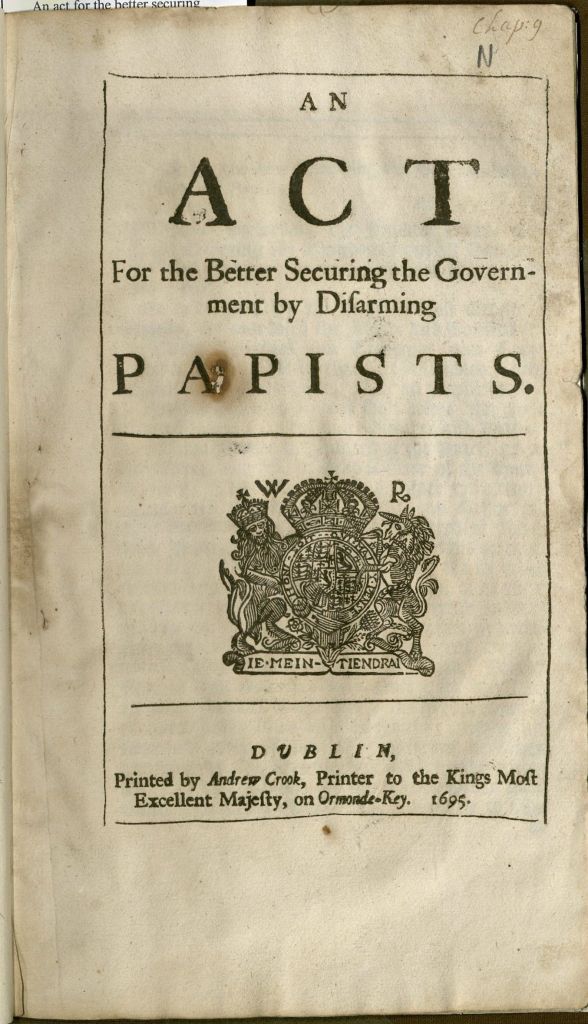
Furthermore, it should be noted that the Penal Laws weren’t just a one-time occurrence. The original legislation was expanded upon multiple times over multiple decades, creating a multi-generational cycle of abuse which multiple English monarchs contributed to, in addition to countless Parliament members. It followed a disconcertingly similar pattern to the Nazi Party’s approach of removing Jewish rights, taking things away in small increments over time to make the injustice appear less alarming. Astoundingly, though the repealing of the Penal Laws began in the 1770’s, the final vestiges of these political structures weren’t revoked until the 1920’s. The Ireland of Jonathan Swift’s time wasn’t just suffering from legislative acts, though. There were very real problems with food supply and economic stability, which we’ll now look a bit closer at.
Famine, The Enclosure Movement, and Poverty
When people think of Irish famine, they generally think of the Great Hunger of 1845-1852 or perhaps the Great Frost Famine of 1740-1741. These events absolutely had a significant impact on both Ireland and the larger world, and shouldn’t be ignored, but they actually weren’t the only major hunger crises in Irish history. The oft-forgotten Irish Oat Famine occurred from 1728-1729, and Swift was appalled by both the sheer horror of the event and the lack of relief efforts being undertaken. Beginning in 1729, Ireland suffered three successive failed harvests, causing food shortages and rising prices in an already poverty stricken nation11. Not only this, but Irish farmers had been steadily losing their lands for decades due to the enclosure movement (which was also occurring in England and Scotland at the time), a push that took land from families who tilled fields to farm food and fenced in their land to make way for livestock pastures. The land, once this had happened, no longer belonged to the original owner, but instead a wealthy landowner of some form12. In the case of Ireland, these landowners were very often English Protestants, not Irish Catholics, actions which were legally justified by the Penal Laws.
During this period, there were instances where Irish peasants actually attacked cows and other livestock in protest of the way that animals were being given the land which the peasants believed to be their rightful property. Swift played into this idea in A Modest Proposal, taking the issue a step further by suggesting that the next generation of English food could be Irish infants, since they were evidently viewed as inferior to livestock. Notice how Swift describes children:
“A child will make two dishes at an entertainment for friends, and when the family dines alone, the fore or hind quarter will make a reasonable dish, and seasoned with a little pepper or salt, will be very good boiled on the fourth day, especially in winter.”
-Jonathan Swift, A Modest Proposal
Hind quarter? That’s not exactly a medical term; it belongs to the profession of butchery. Swift appears to have wanted readers to notice this dehumanizing style of description, possibly to help them realize how inhumane their less cruel, but still unethical, treatment of the Irish populace had become. Here’s another example:
“Some persons of a desponding spirit are in great concern about that vast number of poor people, who are aged, diseased, or maimed; and I have been desired to employ my thoughts what course may be taken, to ease the nation of so grievous an incumbrance. But I am not in the least pain upon that matter, because it is very well known, that they are every day dying, and rotting, by cold and famine, and filth, and vermin, as fast as can be reasonably expected. And as to the young labourers, they are now in almost as hopeful a condition. They cannot get work, and consequently pine away from want of nourishment, to a degree, that if at any time they are accidentally hired to common labour, they have not strength to perform it, and thus the country and themselves are happily delivered from the evils to come.”
-Jonathan Swift, A Modest Proposal
Observe how he speaks of the dying of the poor not as a shocking epidemic to be addressed from a humanitarian standpoint, but a widely-accepted “incumbrance” to the wealthier classes. It appears plausible that Swift viewed the English response to Irish poverty and suffering as a cold, bureaucratic one which made little effort to help unless some aspect of the poor’s suffering began to personally affect them.
To conclude, there were quite a lot of factors that contributed to Swift’s writing of A Modest Proposal. Ireland’s history under English authority, religious differences, prejudiced legislation, poverty, and even famine were all things which Swift witnessed, tried to address in more traditional ways, and eventually exposed using satire. Reader, if you haven’t ever read the full satire, I’d encourage you to do so. It’s a short piece, and I still vividly remember the shock I felt when I first read it. If you’ve read it in the past, I’d still encourage you to at some point reread it with this newfound context in mind. Either way, hopefully you learn something from it, and from the topics we’ve discussed today. There’s a lot to reflect on from satires such as A Modest Proposal.
Notes:
- Jonathan Swift, “A Modest Proposal,” 1729, accessed August 26, 2026, Quotidiana.
- Poetry Foundation, “Jonathan Swift,” Poetry Foundation, 2019, https://www.poetryfoundation.org/poets/jonathan-swift.
- Poetry Foundation, “Jonathan Swift.”
- Poetry Foundation, “Jonathan Swift.”
- Poetry Foundation, “Jonathan Swift.”
- Friedrich Engels famously observed in an 1856 letter to Karl Marx that “Ireland may be regarded as the first English colony”. Trinity College Dublin, Swift’s own alma mater, recently made the same claim in an article by Professor Jane Ohlmeyer.
- Jane Ohlmeyer, “How Ireland Served as a Laboratory for the British Empire,” Www.Tcd.Ie, December 31, 2023, https://www.tcd.ie/news_events/articles/2023/how-ireland-served-as-a-laboratory-for-the-british-empire/.
- Jane Ohlmeyer, “How Ireland Served as a Laboratory for the British Empire.”
- Jane Ohlmeyer, “How Ireland Served as a Laboratory for the British Empire.”
- Sir Henry Parnell, “A History of the Penal Laws against the Irish Catholics,” MacMillan Center for International and Area Studies at Yale, 2025, https://macmillan.yale.edu/glc/history-penal-laws-against-irish-catholics.
- Matthew Wills, “What Was Behind Jonathan Swift’s Modest Proposal? – JSTOR Daily,” JSTOR Daily, September 30, 2025, https://daily.jstor.org/what-was-behind-jonathan-swifts-modest-proposal/.
- Matthew Wills, “What Was Behind Jonathan Swift’s Modest Proposal? – JSTOR Daily,”
Bibliography:
Ohlmeyer, Jane. “How Ireland Served as a Laboratory for the British Empire.” Www.Tcd.Ie, December 31, 2023. https://www.tcd.ie/news_events/articles/2023/how-ireland-served-as-a-laboratory-for-the-british-empire/.
Parnell, Sir Henry. “A History of the Penal Laws against the Irish Catholics.” MacMillan Center for International and Area Studies at Yale, 2025. https://macmillan.yale.edu/glc/history-penal-laws-against-irish-catholics.
Swift, Jonathan. “A Modest Proposal.” 1729. Accessed August 26, 2026. Quotidiana.
Poetry Foundation. 2019. “Jonathan Swift.” Poetry Foundation. https://www.poetryfoundation.org/poets/jonathan-swift.
Wills, Matthew. “What Was Behind Jonathan Swift’s Modest Proposal? – JSTOR Daily.” JSTOR Daily, September 30, 2025. https://daily.jstor.org/what-was-behind-jonathan-swifts-modest-proposal/.


 The Alexicon
Leave a comment