On The Alexicon, I’ve spent quite a long time talking about Voltaire, as a byproduct of the time and research that I’ve spent in order to translate Candide. Plenty of context has been provided surrounding that particular work, and Voltaire’s antics have slipped into a number of my other articles, especially those concerning Frederick the Great, but I’ve not yet had a chance to do a dedicated piece on Voltaire’s overall literary output. Candide is excellent, yes, and I do truly believe that it’s a great starting point for Enlightenment philosophy as a whole, but there’s more to this man than just one satire. Ironically, he didn’t even like Candide very much, placing significantly more emphasis on his “serious” plays, poems, and historical works (see my article, The Context Surrounding “Candide,“ for more details). So, where might Voltaire have wanted you to start? What works give the best insight into who he was as a person? Let’s break it into categories, and you can start with whatever sounds most appealing. I’ll give my personal recommended reading order at the end of the article, too.

Most Famous Work: Candide
This one probably doesn’t come as a surprise. Candide is arguably the most well-known of Voltaire’s works, likely because its humorous style is more appealing to the average reader than an old play or political attack is. Plus, it’s a relatively short work, generally not exceeding 150 pages, though this can vary based on which edition you’re reading from and how much extra commentary it contains.
Voltaire chose to write Candide because he was deeply irritated by the sense of blind optimism which he felt was pervading Europe in spite of horrific disasters such as the Lisbon Earthquake and the Seven Years’ War, both of which are featured prominently in the book (again, see my other article for a full examination of the book’s inspirations). He felt that the general populace was excusing every terrible thing that happened to them as something that just had to occur as the natural order of the world, and that the alternative scenarios could arguably be even worse.
Therefore, Voltaire uses satire to follow the adventures of Candide, a fictional young man who goes all around Europe and even at one point finds himself in South America, constantly chased by angry authorities and encountering horrific suffering at nearly every turn. Despite this, he relies confidently on the belief which his teacher, Dr. Pangloss, instilled in him, that everything is for the best, since they are all living in the best of all possible worlds1 . The tragedies are exaggerated to a rather hilarious extent, so it makes for memorable reading.
If your main goal is to get familiar with what the general public commonly associates Voltaire with, this is a good starting point.
For Studying his Beliefs/Activism: Treatise on Tolerance
Though Voltaire started off his career as a playwright, and later moved into the sphere of history, a notable portion of his later literary output focused heavily on exposing and criticizing injustice. A strong example of this is his Treatise on Tolerance (Traité Sur la Tolerance, in French), in which he viciously criticizes the persecution which was taking place across Europe due religious fanaticism, often between Protestant and Catholic Christians2. They were of the same core faith, yet during this period, extremist members of each group viewed the other as heretics, and Voltaire was appalled by this. In fact, he attacked fanaticism in a number of his works, including entries in his Dictionnaire Philosophique and Mahomet, a play which focuses on how blind zeal can lead followers of a spiritual figure (in this case, Mohammad) to commit atrocities and defend them as acts of piety.
In his treatise, Voltaire claims that violence against other human beings is unacceptable, especially when these violent acts are committed based on different religious opinions.
Each chapter in the work covers a different subtopic or argument related to religious intolerance. Notable examples include The Idea of the Reformation (Chapter 3), which unpacks the Reformation, conflicting ideas between branches of the church (e.g. the existence of Purgatory), and the injustices that occurred as a direct result3. Also, there’s Whether Intolerance was Taught by Jesus Christ (Chapter 14) in response to the people who claimed that they were following Jesus’ teachings by torturing and killing perceived heretics. Voltaire pulls historical accounts, Biblical analysis, letters, and all other manner of research into his work to create what I believe is a very well-articulated argument, but the material itself is made even more impactful when we know what prompted Voltaire to write this work.
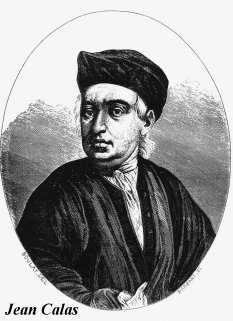
Though Voltaire had expressed criticism of fanaticism-based violence for many years already, one particular event deeply enraged him. Jean Calas, an elderly Protestant man, sadly lost his son, Marc-Antoine, to suicide. Calas was heartbroken, but the most appalling part of the story was that people began accusing him of murdering his own son, as they were under the impression that Marc-Antoine, like one of his brothers, had chosen to become a Catholic. They thought that Jean Calas had chosen to kill a man whom he viewed as a heretic, even though Voltaire affirms that “he (Jean) seemed to be so far from the absurd fanaticism that is breaking the bonds of society that he approved the conversion of his son Louis Calas, and for thirty years employed a zealous Catholic woman, who had reared all his children.4” Clearly, this was not a man who would’ve turned murderous based on a change in his son’s faith. Even the court records which Voltaire read when examining the case claim that,
“I shan’t describe the grief and despair of the father and mother, whose cries were heard by the neighbours.5“
–Treatise on Tolerance, Chapter 1
The story of Calas’ perceived guilt started with the yell of one bystander, but the story grew in a way which chillingly resembled the Salem Witch Trials, evolving into a vicious narrative which culminated in Jean Calas’ execution. Voltaire was so vocally horrified by this story that it motivated him to write the entirety of his Treatise, and he spend the opening chapters of the work breaking down just how impossible it was that Calas could’ve murdered his son. The work is fascinating, and you can really understand what Voltaire believed, but he gives abundant evidence to defend his opinions, turning it into an easily readable yet rather educational work.
For Understanding his Academic Side: La Henriade
In the wake of works such as Candide and Treatise on Tolerance, it can be easy to forget that Voltaire didn’t engage in the forms of literary activism which he became most famous for until much later in his life. Early on, he was a historian and playwright, and his skills combined boldly to create La Henriade, an epic poem written to celebrate the life and accomplishments of King Henry IV. It chronicles the French wars of religion, and Voltaire hoped to use it to give the French people a sense of unified history and national identity6. He heavily uses allusion for this piece, similar to how Homer, Virgil, and other epic poets wrote their works, and given Voltaire’s desire for recognition and pride in many of his own works, it seems reasonable to conclude that he may have done this intentionally. Just compare these two passages from La Henriade and The Aeneid:
Like a tender flower, that one morning sees bloom
from Zephyr’s kisses and Aurora’s tears,
shines for a moment to the eyes, and falls, before its time,
under the iron’s edge, or under the winds’ effort.
(La Henriade, 3.215–18)7
And now, Virgil’s work:
Like the crocus flower cut down by the plough, or a poppy dying as it languishes, head dangling on exhausted neck, bowed down by the storm.
(Aeneid, 9.435–37)8
Both excerpts are rather beautiful, but one can’t deny that they sound similar. However, while Virgil leaned heavily on sensory descriptions to place the reader within a setting, Voltaire largely ignores them, focusing more on abstract language meant to make the reader recall certain concepts (death, conquest, etc.)9. Still, it’s a very entertaining poem, and during his lifetime, it was incredibly popular, so it can give insight not only into Voltaire’s writing style for more formal and poetic works, but also for what the French public viewed as appealing during this period.
Voltaire as a Playwright: Oedipe (Oedipus)
Voltaire wrote plays throughout his life, but Oedipe was his first one, written partially while he was imprisoned in the Bastille. It was wildly successful, earning him significant fame and a royal pension, and it was notably this event that prompted him to begin writing under the name “Voltaire.10“
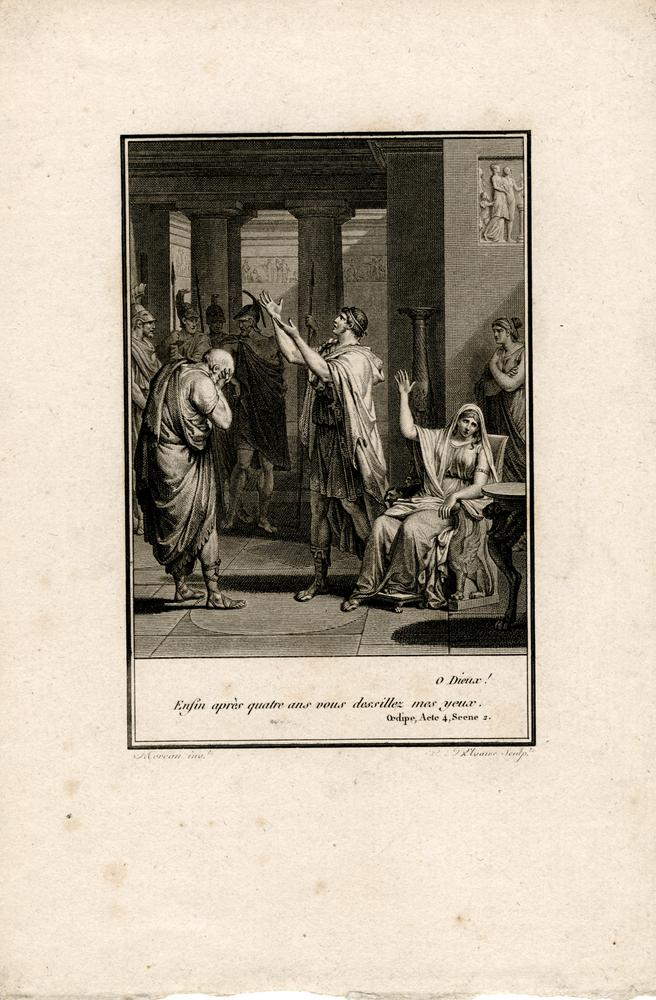
The play draws from the Greek tragedy of Oedipus (Oedipe is the French form of Oedipus), a man who unknowingly killed his father and married his mother in a cruel twist of fate. Unlike Sophocles’ original version, Voltaire leans heavily into emotion and sentimentality, plus infuses the piece with Enlightenment-era ideals and commentary on the nature of human responsibility for actions. There’s an additional subplot revolving around Philoctetes, a former suitor of Queen Jocasta who’s suspected of murdering King Laius, creating further political and romantic tension throughout the piece.
Though Voltaire had many excellent plays, this one is the ideal starting point for a number of reasons. Firstly, it’s the play that set his literary career in motion, and that alone makes it significant. The fact that it parodies a well-known story is also ideal, as readers can more easily identify Enlightenment philosophy and social critiques when they’re already familiar with the base material of something. It makes any differences glaringly obvious, leading us to question their significance. Finally, it’s just a very readable play, and in my opinion, quite an enjoyable one.
Biographies on Voltaire: Voltaire and the Century of Light or Voltaire in Love
Abundant biographies have been written concerning Voltaire’s life, philosophy, writing, and even lovers. Two have stood out to me as ideal starting points, especially for readers entering without much background knowledge.
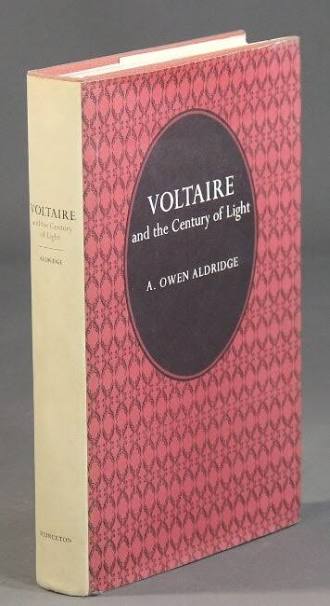
First, Voltaire and the Century of Light by Alfred Owen Aldridge is an excellent examination of Voltaire’s whole life and greater significance, written in an academic yet still readable style. For a reader who wants to get the “full picture” of Voltaire, at least as much as one book can provide, this is a great option. However, it can be surprisingly hard to locate a copy of it without paying textbook-level prices, as the original book was written in 1975 and is no longer widely circulated. I found my copy at a used bookstore for about $20, and checking secondhand book dealers and local libraries will probably be your best bet for getting an affordable copy. If you can’t find one, the Voltaire Foundation, run by the University of Oxford, has some great digital resources that cover similar topics.
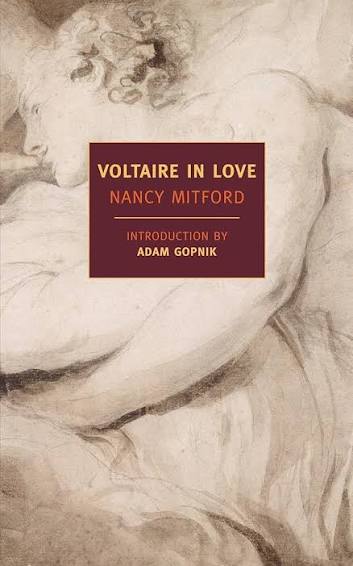
The other book I’m recommending is significantly easier to find. Voltaire in Love, by Nancy Mitford, focuses heavily on the relationship between Voltaire and Emile du Chatelet, but explains other aspects of his life, as well. It’s written in an almost gossip-like style, making it highly readable and much less “dry” than some university-published works. Mitford has a number of other biographies, too, all of which I’ve read and wholeheartedly recommend. The only downsides to this book are that the writing doesn’t go quite as deep as some other biographies, and it is noticeably focused on one aspect of Voltaire’s life instead of his entire self. Still, it’s well worth a read, especially if you’re intimated by traditional history books.
My Personal Recommendations:
If I were beginning to read Voltaire with little to no prior knowledge of his works, here’s the order that I would personally recommend reading the aforementioned titles in.
- Candide
- Treatise on Tolerance
- Voltaire and the Century of Light
- Oedipe
- Voltaire in Love
- La Henriade
However, there’s really no wrong way to go about reading an author or learning about him. Feel free to choose your own reading order, or only read one or two of his works. As long as you’ve learned something new, you should feel proud of yourself.
Notes:
- Voltaire, Candide (1759; Trans. by A. N. Carlson, s. d.).
- Voltaire, Traité Sur la Tolerance. 1763; Paris: Ellipses-Marketing, 1999.
- Voltaire, Traité.
- Voltaire, Traité.
- Voltaire, Traité.
- “La Henriade – Voltaire Foundation.” Voltaire Foundation, July 11, 2024. voltairefoundation.wordpress.com
- Voltaire, La Henriade. 1723; London/United Kingdom: Burton and Company, 1797.
- Virgil. The Aeneid. Trans. by Sarah Ruden. New Haven: Yale University Press, 2008.
- “La Henriade – Voltaire Foundation.”
- Aldridge, A. Owen. Voltaire and the Century of Light. Princeton, N.J.: Princeton University Press, 1975.
Bibliography:
Aldridge, A. Owen. Voltaire and the Century of Light. Princeton, N.J.: Princeton University Press, 1975.
“La Henriade – Voltaire Foundation.” Voltaire Foundation, July 11, 2024. voltairefoundation.wordpress.com
Voltaire. Candide. 1759; Trans. by A. N. Carlson, s. d.
Voltaire. La Henriade. 1723; London/United Kingdom: Burton and Company, 1797.
Virgil. The Aeneid. Translated by Sarah Ruden. New Haven: Yale University Press, 2008.
Voltaire. Traité Sur La Tolérance. 1763; Paris: Ellipses-Marketing, 1999.


Leave a Reply