Opera has often been regarded as a rather stuffy, old-fashioned form of expression, but there’s quite a lot to appreciate if you take the time to actually explore it. It’s an art form with a rich legacy, an integral part of understanding the 18th-century arts scene, and the basis of many of the most famous musical creations of the period. I recently completed a Harvard course by Professor Forrest Kelley on this topic, and found it quite enlightening, so I wanted to share my findings1. Of course, a short article is in no way equal to the value a true deep dive into a subject, but not everyone has time for that kind of commitment, and that’s completely understandable. That’s one of the reasons why The Alexicon exists. I would strongly encourage readers to take the full online course for themselves, though, if they have the opportunity to do so, as it is completely free and provides quality content.
This particular branch of the opera course (there is also a portion on 19th-century opera, which is excellent but not relevant to this period) focused on two productions, Mozart’s Don Giovanni and Handel’s Giulio Cesare in Egitto. We trace through the lessons opera’s evolution across the century by examining differences in various composers, performances, and public reactions, but this is difficult to accomplish without understanding opera vocabulary first. Let’s go over some basic terms. Late in the article, we’ll also work on primary source interpretation.
Essential Vocabulary
Libretto (little book):2 a small book which has the lyrics of the opera printed in it, along with a translation in the primary language of whatever country the show is being performed in (e.g. in England, an Italian opera’s libretto would contain both the original Italian and an English version, with one language printed on the left page, and one on the right). These were sold before the show for a small fee.
Librettist:3 the person who writes the lyrics of the opera, creating the actual story line.
Composer:4 the person who writes the music for the opera. He will often also conduct the orchestra for the show’s first few performances. Mozart and Handel were both composers.
Aria:5 long, emotional song sung by a single character. It is meant to express inward feelings which the character may never actually reveal for the other characters in the show, and sometimes, the person singing the aria will be the only person on stage during a given scene. To make a modern comparison, the song “Wait for It,” from Hamilton, is technically an aria.
Recitative:6 a song which acts as a form of dialogue, where the lyrics are direct communication between characters. Continuing the Hamilton analogy, both versions of “Cabinet Battle” would be considered recitatives.
The Culture Surrounding Opera
When people go to the opera today, they are expected to sit quietly and attentively and listen to the performance. This was not the case in the 18th century. Many of the attendees were aristocrats who held season tickets, where they would buy a box which had a front area visible to other show-goers, and a back area which nobody could see them in. They would often talk, play cards, and even have food and drinks, only paying attention to the show when their favorite singers were performing.7 It was viewed as a sort of social gathering. Interestingly, some of these box seats were actually set right next to the stage, even far enough back that viewers would be looking at some performers from the back. This was accepted as perfectly normal at the time.
Furthermore, people were actually allowed to sit on the stage if they paid premium ticket prices. Wealthy nobles would often have chairs on benches on the sides of the stage, within a few feet of the actual performers, and they were known to walk around and even talk to singers in the middle of the show.8 Such behavior would get you kicked out of an opera house nowadays, and even in the 18th century, many people found it irritating. This trend thankfully died out as the century went on, though. In France, Voltaire (whom people often forget was first known as a playwright, not a satirist or social reformer) and Denis Diderot advocated strongly for the banning of this practice, and it slowly stopped beginning in the late 1750’s, for both stage plays and opera productions9. In England, the Drury Lane theater banned stage seating in 1763, and other venues gradually followed their example10. Audience etiquette didn’t begin to match how we watch shows today until Wagner’s time, though. He strictly enforced quiet behavior, plus dimmed the lights for his shows, during his 1876 Bayreuth Opera Festival11. Since this festival was so influential, to the point that it actually still occurs today, other theaters began adopting Wagner’s standards.
Observing a Primary Source
An important part of historical education is learning how to examine primary sources. Let’s look at this contemporary painting to better understand how opera culture was characterized in the 18th century. It is a famous piece, and was created as an interesting social commentary of the time.
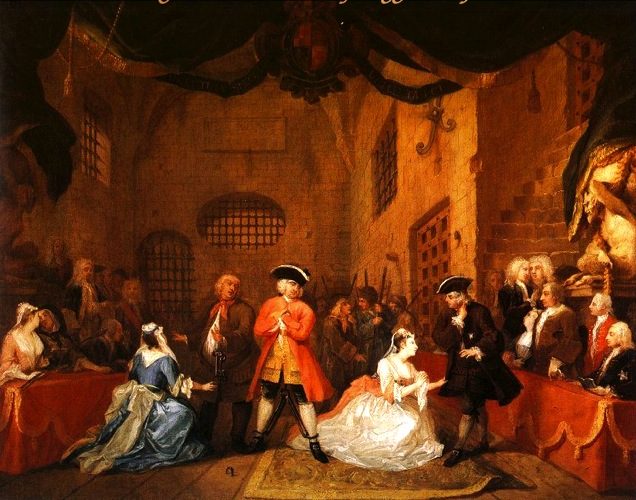
Notice the side tables, and the elaborate clothing of the people sitting at them. We can conclude by their appearances that these people are unusually wealthy. Silk, velvet, and heavily layered clothes were all expensive in the 18th century, and were generally used as status symbols. These people are sitting extremely close to the characters, to the point of arguably disrupting the show.
Think about the following questions:
1. How does the painting make you feel about the aristocrats of this time?
2. What do you think Hogarth thought of them, judging from his painting? Does he portray them positively, negatively, or neutrally?
3. Look at the people in the back of the painting. Do you think they’re performers, or have they come to watch the show? Do you think Hogarth made their identities ambiguous on purpose?
One of our vocabulary terms is shown in this painting, too. Pay attention to the man dressed in black on the far right. The book he is holding is a libretto, and since opera houses were at this point lit by hundreds of candles, it was easy to read the libretto during the show. However, operas were generally rehearsed in relative darkness, in an attempt to save money12. This is quite different from show rehearsal styles today, where early rehearsals often take place in a fully lit room, with stage lighting and a dark theater only being introduced once the singers are familiar with the music and blocking (where they’re supposed to sit/stand for different scenes) of the performance.
The opera itself which this painting is portraying is also rather unique. It was called The Beggar’s Opera, and it was a parody of the opera serias, or serious operas, which were so popular at the time. The storyline follows a collection of lowlife criminals through a strange set of misfortunes in a mock tragic style, their actions and the actions of other background characters meant to criticize the behavior and hypocrisy of the rich and powerful. This actually made it quite a risky show to produce, and multiple theaters turned it down. It became quite popular once it was performed, though, being rather sensational in its early years and bringing in more than double the profits its patrons anticipated13.
Giulio Cesare vs. Don Giovanni: Examples of Opera’s Evolution Over the Century
Giulio Cesare in Egitto was written by Handel in 1724, for England’s Royal Academy. Don Giovanni, on the other hand, was written by Mozart in 1787, over 50 years later14. Think about how music styles have changed from the 1970’s until now. Just like modern music, 18th-century composition styles evolved as time passed, and if you know what to look for, you can see some interesting experimentation taking place between the two shows. Part of this, of course, is due to the fact that Mozart especially was known to be a very innovative composer, testing the limits of musical conventions.
Firstly, let’s compare the content of the two operas. Giulio Cesare is a combination of grand political drama and romance, following Giulio Cesare (Julius Caesar) as he falls in love with Queen Cleopatra and helps her seize power from her half brother, Tolomeo (Ptolemy). Love, revenge, betrayal, and struggles for power are primary themes throughout the work15.
Don Giovanni, on the other hand, involves the rather dark story of a cruel, horrible man finally getting punished for his actions. He’s a serial seducer and responsible for murder, and finally faces divine retribution for his actions. These darker themes were well-received by general audiences of the time, pointing to a fascinating change in public interests.
The musical style of the two operas is also rather different. Giulio Cesare follows the conventions of Baroque Opera, with lots of arias which are meant to demonstrate the singers’ skills through elaborate changes in notes and rhythm. It also features a number of castrato roles, which require male singers with incredibly high voices16. Nowadays, these roles are sometimes actually sung by female singers in male costumes. Don Giovanni is a bit more creative. Different styles of music, from dramatic arias to folk songs, are incorporated to demonstrate the social classes of various characters, and comedic scenes mix with tragedic plotlines17. This combining of concepts was not common at the time.
Both shows deal with deep questions about human nature and the what people will do for and as a result of love, yet they express these ideas in very different styles. It’s a fascinating contrast.
Bonus: Comparing Operas and Musicals
Both operas and musicals involve lots of singing, but where in operas, the singing is basically nonstop, musicals often feature scenes of pure dialogue, using songs as a method of conveying dramatic moments or personal shows of emotion and longing18. Musicals require the audience to understand the language of the lyrics and dialogue in order to understand what is occurring in the plot. Operas, on the other hand, have attracted fans for centuries who have no understanding of the show’s language. Since opera relies so much on the musical composition of a piece, instead of the specific words, audiences can still generally understand what’s happening19. The vocal styles are also different, with operas generally focusing on loud voices with heavy vibrato, due to the fact that opera was first popularized long before microphones existed20. Both opera and musical theater include lots of song, dance, and acting, but these arts just manifest themselves in different ways.
Notes:
- Harvard University, “18th-Century Opera: Handel & Mozart” (online course, HarvardX), https://www.edx.org/learn/music-theory/harvard-university-18th-century-opera-handel-mozart.
- Harvard University, “18th-Century Opera.”
- Harvard University, “18th-Century Opera.”
- Harvard University, “18th-Century Opera.”
- Harvard University, “18th-Century Opera.”
- Harvard University, “18th-Century Opera.”
- Harvard University, “18th-Century Opera.”
- Victoria and Albert Museum, “A Night at the Opera,” April 17, 2024, https://www.vam.ac.uk/articles/a-night-at-the-opera?srsltid=AfmBOoo7uKtkEKWZ-QCtkP7_59TxxTFptMpCsjkjT7SHj8wIpfcY_Ta8.
- Voltaire, “Dissertation sur la tragédie ancienne et moderne,” in Œuvres de 1746–1748 (I), ed. W. H. Barber and Christiane Mervaud, vol. 30A of Les Œuvres complètes de Voltaire (Oxford: Voltaire Foundation, 2003), 48
- The London Stage, 1660–1800: A Calendar of Plays, Entertainments & Afterpieces Together with Casts, Box-Receipts and Contemporary Comment, ed. George Winchester Stone Jr., part 4, vol. 2: 1747–1776 (Carbondale: Southern Illinois University Press, 1962), 945–950
- Bayreuther Festspiele, “The Bayreuth Festival,” accessed August 17, 2026, https://www.bayreuther-festspiele.de/en/.
- Harvard University, “18th-Century Opera.”
- Berta Joncus, “The Beggar’s Opera: A Guide to Why and When It Was Composed and Its Legacy in Musical Theatre,” Classical Music, June 15, 2026, https://www.classical-music.com/features/works/the-beggars-opera-guide.
- Harvard University, “18th-Century Opera.”
- Harvard University, “18th-Century Opera.”
- Harvard University, “18th-Century Opera.”
- Harvard University, “18th-Century Opera.”
- Freya Parr, “What Is the Difference Between a Musical and an Opera?,” Classical Music, June 15, 2026, https://www.classical-music.com/articles/what-is-the-difference-between-a-musical-and-an-opera.
- Parr, “What Is the Difference Between a Musical and an Opera?”
- Parr, “What Is the Difference Between a Musical and an Opera?”
Works Cited
Bayreuther Festspiele. “The Bayreuth Festival.” Accessed August 17, 2026. https://www.bayreuther-festspiele.de/en/.
Joncus, Berta. “The Beggar’s Opera: A Guide to Why and When It Was Composed and Its Legacy in Musical Theatre.” Classical Music, June 15, 2026. https://www.classical-music.com/features/works/the-beggars-opera-guide.
Kelly, Thomas Forrest. 18th-Century Opera: Handel & Mozart. HarvardX. Accessed August 13, 2026. https://www.edx.org/learn/music-theory/harvard-university-18th-century-opera-handel-mozart.
Parr, Freya. 2026. “What Is the Difference Between a Musical and an Opera?” Classical Music. June 15, 2026. https://www.classical-music.com/articles/what-is-the-difference-between-a-musical-and-an-opera.
The London Stage, 1660–1800: A Calendar of Plays, Entertainments & Afterpieces Together with Casts, Box-Receipts and Contemporary Comment. Part 4, Vol. 2: 1747–1776. Edited by George Winchester Stone Jr. Carbondale: Southern Illinois University Press, 1962.
Victoria and Albert Museum. “A Night at the Opera,” April 17, 2024. https://www.vam.ac.uk/articles/a-night-at-the-opera?srsltid=AfmBOoo7uKtkEKWZ-QCtkP7_59TxxTFptMpCsjkjT7SHj8wIpfcY_Ta8.
Voltaire. “Dissertation sur la tragédie ancienne et moderne.” In Œuvres de 1746–1748 (I), edited by W. H. Barber and Christiane Mervaud, 41–60. Vol. 30A of Les Œuvres complètes de Voltaire. Oxford: Voltaire Foundation, 2003. [, 2]
———. “The Beggar’s Opera: A Guide to Why and When It Was Composed and Its Legacy in Musical Theatre.” Classical Music, June 15, 2026. https://www.classical-music.com/features/works/the-beggars-opera-guide.


Leave a Reply