When one wanders through a modern-day supermarket, it is common knowledge that fruits are seasonal. The watermelon enjoyed in July will likely be unavailable in January, and even if it can be found, it has to be shipped from absurd distances to make it to such a store. In the 18th century, this was also the case, and to a much greater extent. The abundance of international trade and empire-building led the wealthier side of the European public to experience foods they had never before known, and made foreign commodities like tea and spices steadily more affordable to even the bourgeois. Importing tropical commodities was still an expensive process, though.¹
Yet, out of all these foreign foods and commodities, one stood out as a distinctive symbol of status. It was an item so rare and valuable, it could even be rented out as a display item for aristocratic banquets.² Not a food to be eaten, no. It was considered a bold show of wealth simply to possess one. Actually eating it marked you as near-royalty, in terms of riches.
So, what was this item? A pineapple, of course.
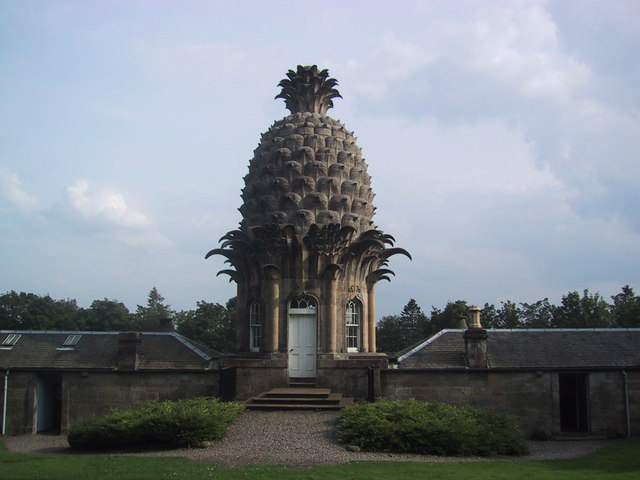
Indeed, these golden fruits were surprisingly coveted, even making their way onto objects of household decor, such as the rather unique piece shown above. Their spiny exteriors and acidic flesh were unlike anything native to Europe, where even plants like corn and squash had to be introduced from the New World. In the eyes of kings such as Charles II of England and Louis XV of France, the strange fruit was viewed as a symbol of colonial achievement and high luxury. The spiky appearance of a pineapple would have been cause enough for intrigue, in the 18th century, but it was their point of origin that truly made them valuable. Pineapples were shipped all the way from the Caribbean, where wealthy plantation owners were exploiting slave labor to grow sugar, tobacco, and all other manner of exotic commodities.³ It was a brutal system, especially in modern eyes, but the elites of the time tended to view it as a point of national pride and achievement. From their perspective, they were gaining new territories to increase their empires and monopolies over items that hadn’t previously been attainable. It’s quite a fascinating difference in perspective.
Travelers and businessmen would sometimes even gift pineapples to royalty upon returning from the Caribbean, or have them imported through friends in the Atlantic trade, as a gesture of goodwill to their monarch. This notably occurred in the case of John Rose, the Royal Gardener for Charles II, who imported a pineapple all the way from Barbados to present it to his king.⁴

In fact, the painting above was not actually done until 1787, but was based on an earlier version attributed to a Dutch painter named, Hendrick Danckerts. Thomas Stewart repainted it nearly a century afterwards, slightly changing the coloration and the clouds but otherwise replicating the original, likely in an effort to advertise Imperial horticultural abilities.
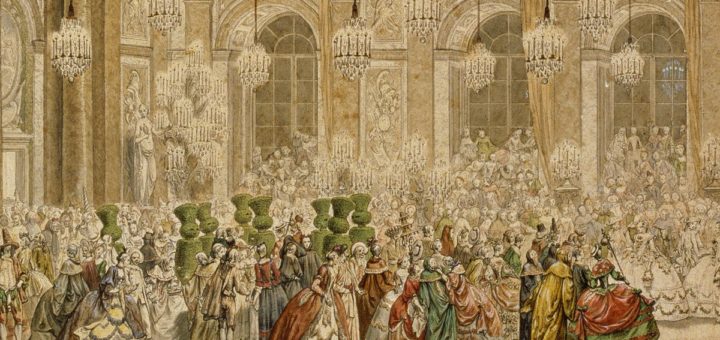
That’s still only referencing a 17th-century interest in pineapples, though. With the foundation set for pineapple-mania, how did the public respond to the fruit in the 18th century? Louis XV certainly liked the fruit. In fact, his own court periodical confirms that during an event called Le Bal des Ifs (the Yew Tree Ball), which was meant to celebrate the dauphin’s marriage, Louis XV and his entourage appeared dressed in elaborate costumes that resembled some sort of plants. Though the official designation states that they were yew tree costumes, one Duke notably dubbed them as “The Pineapple Costumes” due to the strange shape and texture of the costumes’ paper structures.⁵
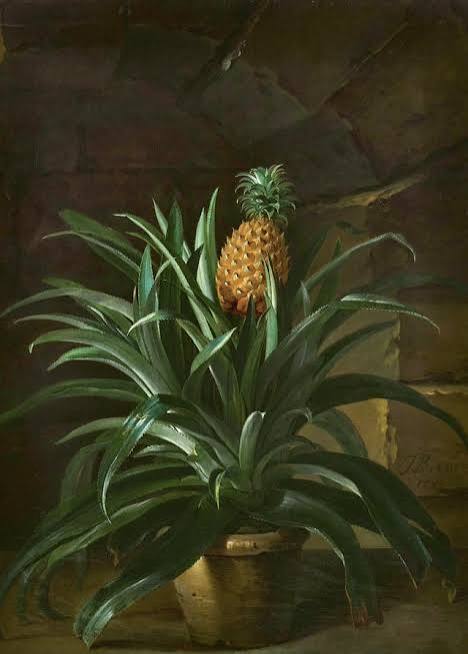
For over a decade before this ball, pineapples had been a point of interest at the French court of Versailles. On Christmas Day in 1733, a pineapple successfully reached maturity in the specially built tropical greenhouses of the palace. When Louis XV was presented with the fruit, he was so enthusiastic about it that he ordered his favorite painter, Jean-Baptiste Oudry, to create a full size picture of the fruit, which was subsequently hung over the king’s golden cabinet.⁶ After this occurrence, noble families across France, as well as England and Scotland, rushed to build their own pineapple greenhouses. Catherine the Great even oversaw the growth of pineapples in the frigid Russian climate, a true feat of science. Maintaining the mock-Caribbean growing conditions required intensive labor, a fully insulated and climate-controlled building, and huge amounts of fuel. It can be presumed that such a pursuit was done in order to prove one’s wealth and power.
Not everyone could afford to personally import or grow their own pineapple, though, and some socially conscious bourgeois families wanted to look wealthy without actually spending the 18th-century equivalent of $8,000 to buy a single pineapple. Therefore, pineapple rental businesses began to emerge, offering pineapples which could be loaned out for a night, displayed in a salon or dining room during some kind of social gathering, then returned back to the company after the event was finished. This cycle would repeat until the fruit rotted, ultimately becoming a lucrative industry. At one point shortly after the end of the 18th century, a pineapple theft actually became a major court case, further emphasizing just how desirable the fruits were.7
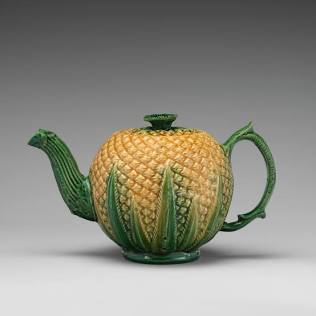
Finally, for the people who couldn’t afford even a pineapple rental but still wanted to be a part of the fad, pineapple-themed home decor became a popular item. Ceramics were sometimes painted with pineapples, and silver items had pineapple designs etched onto their surfaces. Indeed, in all but the lowest levels of European society, pineapple mania was present during this period.
Indeed, though obsessing over pineapples might seem strange from a modern perspective, it really isn’t that different from how we tend to obsess over particular pieces of technology, designer brands, and vacation destinations. Trends themselves can change over time, but it appears that the human tendency to chase after them has remained surprisingly consistent.
Notes
- Henry Colt, The Voyage of Sir Henry Colt to the Islands of Barbados and St. Christopher: May–August 1631(2002).
- John Evelyn, Diary and Correspondence of John Evelyn: To Which Is Subjoined the Private Correspondence between Charles I. and Sir E. Nicholas, and Between Sir E. Hyde and Sir R. Browne, ed. William Bray (1887).
- Colt, The Voyage of Sir Henry Colt to the Islands of Barbados and St. Christopher: May–August 1631.
- Hendrick Danckerts, John Rose Presenting a Pineapple to King Charles II, ca. 1675–1680, oil on canvas, Houghton Hall, Norfolk, UK.
- Charles-Philippe d’Albert, Duc de Luynes, Mémoires du duc de Luynes sur la cour de Louis XV (1735–1758), ed. Louis Dussieux and Eudore Soulié, 6:338–41 (Paris: Firmin Didot Frères, 1861); “Relation des fêtes données à l’occasion du mariage de Monseigneur le Dauphin,” Mercure de France, March 1745, 172.
- Louis Le Normand, “Rapports sur la culture de l’ananas au Potager du Roi,” 1733, Manuscrits du Potager du Roi, Archives Nationales de France, Paris, O¹ Série (Maison du Roi); Jean-Baptiste Oudry, Ananas dans un pot(Pineapple in a Pot), 1733, oil on canvas, 130 × 98 cm, Musée National des Châteaux de Versailles et de Trianon, Versailles, France, inventory no. MV 7035.
- Trial of John Godding, 16 September 1807, Old Bailey Proceedings Online (version 9.0), http://www.oldbaileyonline.org, trial t18070916-41.
Bibliography
Colt, Henry. The Voyage of Sir Henry Colt to the Islands of Barbados and St. Christopher: May–August 1631. 2002.
Danckerts, Hendrick. John Rose Presenting a Pineapple to King Charles II. Ca. 1675–1680. Oil on canvas. Houghton Hall, Norfolk, UK.
d’Albert, Charles-Philippe, Duc de Luynes. Mémoires du duc de Luynes sur la cour de Louis XV (1735–1758). Edited by Louis Dussieux and Eudore Soulié. Paris: Firmin Didot Frères, 1861.
Evelyn, John. Diary and Correspondence of John Evelyn: To Which Is Subjoined the Private Correspondence between Charles I. and Sir E. Nicholas, and Between Sir E. Hyde and Sir R. Browne. Edited by William Bray. 1887.
Le Normand, Louis. “Rapports sur la culture de l’ananas au Potager du Roi.” 1733. Manuscrits du Potager du Roi. Archives Nationales de France, Paris. O¹ Série (Maison du Roi).
Old Bailey Proceedings Online. Version 9.0. http://www.oldbaileyonline.org.
Oudry, Jean-Baptiste. Ananas dans un pot (Pineapple in a Pot). 1733. Oil on canvas, 130 × 98 cm. Musée National des Châteaux de Versailles et de Trianon, Versailles, France. Inventory no. MV 7035..
“Relation des fêtes données à l’occasion du mariage de Monseigneur le Dauphin.” Mercure de France, March 1745, 172.


Leave a Reply