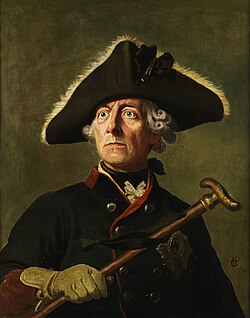
Frederick the Great has often been recognized as one of the most influential and unexpected rulers of 18th-century Europe. He was a talented military leader, government reformer, philosopher, and musician, who leveraged limited resources effectively enough to take his home nation of Prussia from being a subservient member of the Holy Roman Empire to a state respected enough to gain the support of world powers such as England and Russia. However, no individual becomes so notable without exigence. For Frederick the Great, this notably involves the treatment he received at the hands of his father, Frederick William I, a cold, militaristic ruler. Many aspects of Frederick the Great’s adult existence were strongly influenced by his childhood. Through Frederick William I’s tutelage, his son became a skilled yet misanthropic ruler, and Frederick’s choices, preferences, and relationships throughout his adult life can largely be traced back to things that his father either rigidly enforced or viciously suppressed.
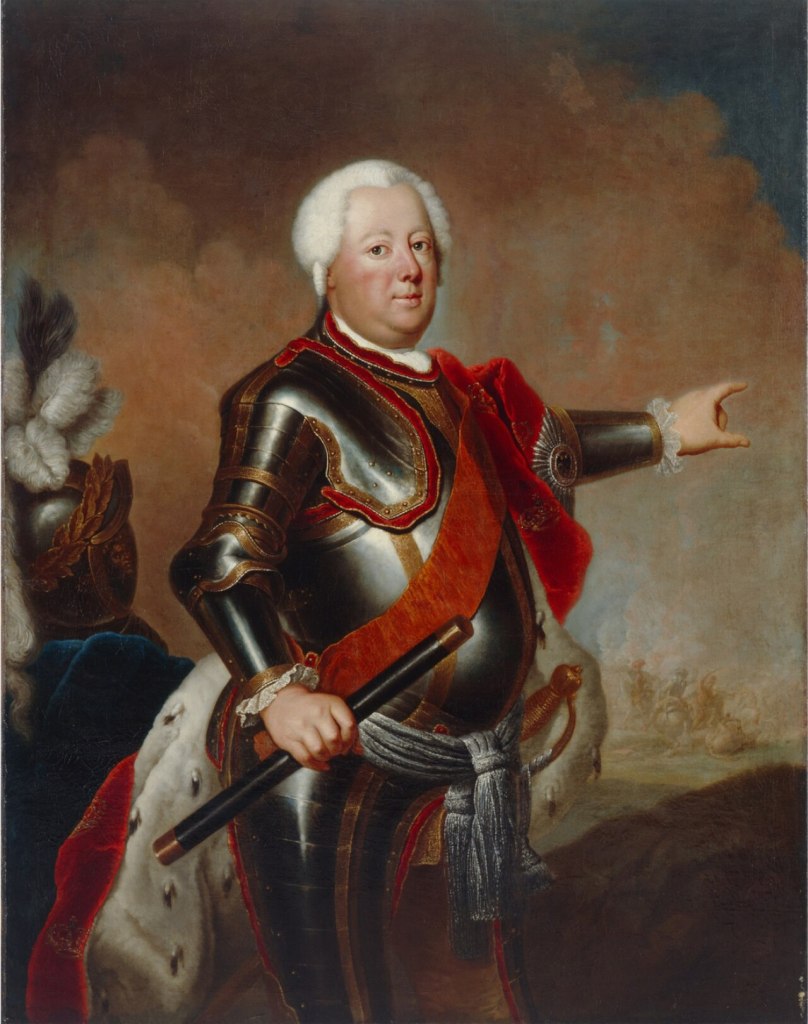
Foremost, it is imperative that the nature of Frederick’s childhood is examined, in order to get a full sense of what he endured. Frederick’s early life was a brutal series of abuses which his father inflicted upon him in an effort to mold the young prince into a hypermasculine future ruler. He was forced to wear a military uniform as everyday dress and spend hours every day drilling maneuvers, studying only practical subjects which his father deemed useful, and enduring evenings in the “Tobacco Cabinet,” a nickname given to his father’s evening social group of like-minded officers and officials. Unfortunately for the king, it appears that Frederick was not only uninterested in manly pursuits but was also rather interested in men. British aristocrat Nancy Mitford affirms that during his adolescent years, he formed two relationships with members of his father’s court which were so intimate that even Frederick’s beloved sister, Wilhelmine, began to question if their nature was truly platonic.^1 Frederick’s more public relationships later in life, with men such as his valet, Michael Gabriel Fredersdorf, and beloved polymath, Francesco Algarotti, further support the theory Frederick was homosexual, something which was considered quite unconventional and even dangerous during the 18th century. His father was appalled by such a thing, and as soon as he suspected Frederick’s passion, he became even more brutally abusive in an effort to force morality back into him.
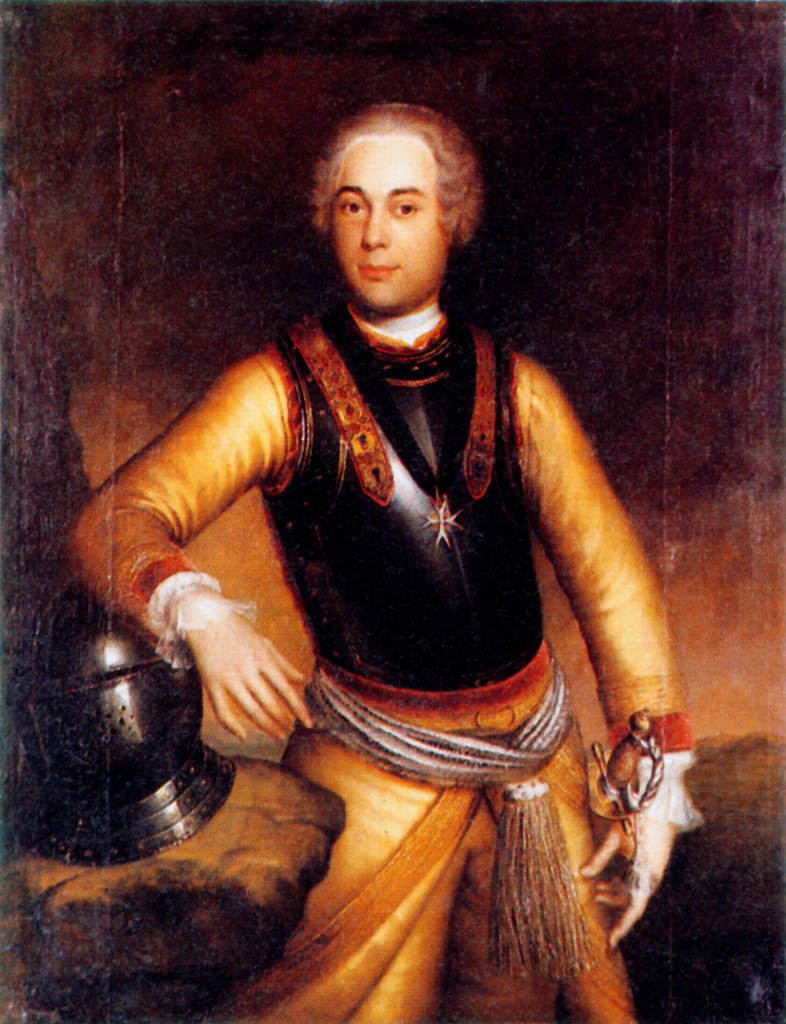
Indeed, Frederick deviated in many ways from the expectations thrust upon him, preferring instead to study the arts and sciences. His father rewarded such preferences with continual physical and mental humiliation, going so far as to, according to military historian Roy Morris Jr., ”on several occasions […] publicly beat Frederick in front of the royal court, once smashing him in the face with a cane and bloodying his nose”^2. The humiliation, degradation, and control which marked the prince’s upbringing left a lasting impression on his leadership mindset later in life. Instead of taking suggestions or criticism from his officials, he chose to make many major decisions on his own and carry them out as he saw fit. Thankfully, Frederick’s overall good judgement meant that these decisions rarely had any major consequences, but the fact that his tendency to behave in such a way appears to have been, nonetheless, at least partially a product of how controlled he felt in his youth. Without such traumatic experiences driving him away from the influence of others, he likely would have settled into a more moderated, advised state of rule. The horrific nature of how Frederick was abused by his father appears to have played a notable role in making him so determined to be an independent, uncompromising ruler.
Additionally, once Frederick William I was dead, the style of court that Frederick kept was distinctly different from that of his father. Frederick the Great was personally involved in designing his summer palace of Sanssouci, where he collected art and surrounded himself with an unusually intimate circle of scholars, artists, musicians, and other enlightened men. In fact, he even wrote a piece for Johann Sebastian Bach, the famed composer, and employed Bach’s son, Carl Emmaneul Bach, as a court musician for much of the man’s lifetime.^3 Notable members of Frederick’s court included Francesco Algarotti, Pierre Louis Maupertuis, and especially Voltaire, one of the most notorious quills of the entire Enlightenment. Through Frederick’s childhood clashes with his father, he became all the more determined to proudly live the lifestyle he desired during his rule. Frederick William I’s vehement criticism of his son’s passions only encouraged Frederick to pursue them.
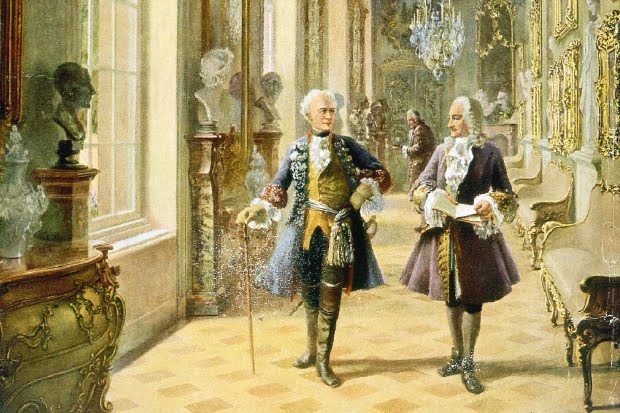
Furthermore, Frederick’s priorities of patronage were intentionally very different from that of his father’s. Renowned historian and former Cambridge professor Timothy Blanning affirms that while Frederick William I massively cut funding for the arts and sciences, his son became a dedicated patron of all forms of art, directing substantial funding to ventures such as opera, sculpture, and scientific experimentation. In fact, Frederick William I’s refusal to fund the arts went so far that for his own funeral, court singers had to be borrowed by the foreign court of Saxony, because there were none to be found in Prussia (Blanning, page 40).^4 Frederick’s patronage of the arts and sciences were not the result of greater resources, either. Both kings had financial struggles at various points. The difference between them was priorities, not capital, and Frederick prioritized these things specifically because he saw how gloomy and stagnant Prussia’s culture could become without them.
He did not just differ in patronage, though, but in his entire view of the legal system. Unlike his father, who led based on fear and intimidation, Frederick led by example and listened intentionally to the complaints of even his lowliest citizens, going so far as to personally involve himself in many legal matters.^5 He advanced his citizens based on their skill and experience, not social status, which was a major change from his father’s style of aristocrat-biased promotion. Within the opening years of his reign, he also abolished a large majority of the torture and censorship laws which had previously lorded over Prussia’s citizens, and created the General Law Code, which helped to establish legal equality regardless of socioeconomic status. Furthermore, he chose to almost completely outlaw execution as a form of punishment, regardless of the crime. The Deutschland Museum believes that this was influenced by the grief Frederick endured when Lt. Katte, his closest confidant, was executed for supposed treason when he tried to help Frederick escape from his father’s dictator-like parenting.^6 Not only were these ideas a major step away from his father’s cruel style of governance, but they were also an incredibly bold new set of legal philosophies which many of Europe’s other nations took decades to adopt.
He advanced his citizens based on skill and experience, not social status.
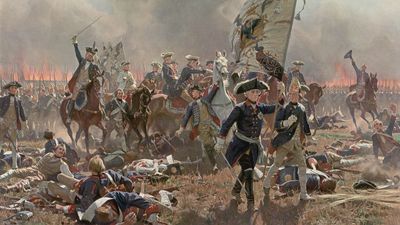
As a final point, one cannot talk about Frederick the Great without discussing his experience as a military leader and strategist. He became notable for fighting what he defined as “wars of interest,” in which a ruler anticipates an enemy’s intentions and invades them before they have an opportunity to launch any actual offensive against said ruler. Frederick fought for economic gain, as well, successfully seizing the Austrian province of Silesia and using it to nearly double Prussia’s economy, wealth, and population, which his father would have approved of. He accomplished this, as historian Michael Stroud states, with “a relatively small, yet highly drilled Prussian army of around 81,000” at a time when Prussia itself was “seemingly surrounded by enemies and … no alliances to speak of”^7. Frederick led a wildly successful campaign as a young ruler, and held on to Silesia for the entirety of his reign despite the efforts of the much larger Austrian empire to take it back. Furthermore, when complicated alliances drew him into the Seven Years’ War, he rallied the incredibly limited resources of his nation and, through feats of strategic brilliance and a few notable instances of luck, survived against multiple world powers. Indeed, this is one area of life where Frederick’s father would have actually approved of his actions. His instruction taught Frederick resilience and resourcefulness, plus gave him a deep understanding of historical military techniques and how they could be applied to modern engagements. Though Frederick despised his early military training, it was the instruction his father forced him to go through which ultimately enabled him to inflict such crushing defeats upon his enemies. Frederick the Great was in some ways just as much of a military man as his father before him.
However, despite all the evidence presented, readers may still object that it seems impossible for any one person to have such a diverse impact on both positive and negative spheres of another person’s life. Frederick William I was a terrible father, but he only existed for the first few decades of his son’s life. These men were both kings, though, not just family members. When an individual holds any sort of power in government, they have to contend with whatever laws and precedents were established by their predecessors. In this way, Frederick William I was directly responsible for many of the issues that Frederick the Great was forced to address throughout his life. Furthermore, as a king, Frederick’s father held power over all the people around Frederick, and was thus able to exert a truly constant pressure of his own beliefs and standards onto his son. Truly, the unusual combination of powers which Frederick William possessed over his son meant that he exerted a strong enough influence to have played an abnormally major role in defining Frederick the Great’s existence.
Indeed, Frederick’s relationship with his father was complicated, fraught with abuse, grief, and harshly clashing ideals. However, they also had very similar ambitions for the Prussian state as a military and economic power, and the wars Frederick fought during his reign would have thoroughly impressed his late father.
Notes
1. Michael Stroud, “Frederick the Great — an Icon and Misguided Monarch,” Military History Now, March 8, 2022, https://militaryhistorynow.com/2022/03/07/frederick-the-great-an-icon-and-misguided-monarch/.
2. Nancy Mitford, Frederick the Great (New York: Harper and Row, 1984).
3. Roy Morris Jr., “Frederick the Great: Early Years,” Warfare History Network, May 23, 2023, https://warfarehistorynetwork.com/article/frederick-the-great-early-years/.
4. “Frederick II – Prussia, Voltaire & Accomplishments | HISTORY,” HISTORY, November 9, 2009, https://www.history.com/articles/frederick-ii-prussia.
5. T. C. W. Blanning, Frederick the Great: King of Prussia (New York: Random House, 2016), 40.
6. Blanning, Frederick the Great: King of Prussia.
7. “The Execution of Katte – Deutschland Museum,” Deutschland Museum, 2025, https://www.deutschlandmuseum.de/en/history/calendar/1730-11-06-the-execution-of-katte/.
Bibliography
Blanning, T. C. W. Frederick the Great: King of Prussia. New York: Random House, 2016.
“Frederick II (Prussia).” Encyclopedia.com. Accessed August 8, 2026. https://www.encyclopedia.com/people/history/german-history-biographies/frederick-ii-prussia.
“Frederick II – Prussia, Voltaire & Accomplishments | HISTORY.” HISTORY. November 9, 2009. https://www.history.com/articles/frederick-ii-prussia.
Mitford, Nancy. Frederick the Great. New York: Harper and Row, 1984.
Morris Jr., Roy. “Frederick the Great: Early Years.” Warfare History Network. May 23, 2023. https://warfarehistorynetwork.com/article/frederick-the-great-early-years/.
Slaughter, Jamie. “Frederick the Great.” George Washington’s Mount Vernon. Accessed August 8, 2026. https://www.mountvernon.org/library/digitalhistory/digital-encyclopedia/article/frederick-the-great.
Stroud, Michael. “Frederick the Great — an Icon and Misguided Monarch.” Military History Now. March 8, 2022. https://militaryhistorynow.com/2022/03/07/frederick-the-great-an-icon-and-misguided-monarch.
“The Execution of Katte – Deutschland Museum.” Deutschland Museum. 2025. https://www.deutschlandmuseum.de/en/history/calendar/1730-11-06-the-execution-of-katte/.


Leave a Reply